Husband Steve here: Welcome to our Reno 2011 Worldcon site-recon report. We're not doing this in any official capacity, but since we were in town anyway, and have worked on a con or two or five ourselves back in the day, we knew there were people out there who would be starved for information.
We spun by the Peppermill Hotel and Casino (Quiet hotel), spent quite a bit of time crawling around the Atlantis Hotel and Casino (the party hotel, and the one connected to the Reno-Sparks Convention Center) and checked the exterior layout on the convention center itself. We took lots of photos of these things and we'll try to lay the photos out with our observations in a way that may be useful to those attending or working on the convention.
Rather than clutter up our "gateway" blog, Yorkwriters.com with this special-interest stuff, we decided to post them on Chris' blog, which hasn't been that busy lately (get posting, Chris!).
So, since we're taking over her blog... Before we go on, a brief word from our sponsor: I know this isn't sf/fantasy (which Chris has published plenty of, by the way), but Chris, under the pen-name Christy Evans, has a new mystery series launching through Berkley Prime Crime this fall, featuring a mystery solving female plumber's apprentice/amateur detective. You can see her gorgeous new cover for the first installment, "Sink Trap," and read all the details on "Christy's" blog. Two more installments are already in the pipeline ("Lead Pipe Cinch" is scheduled for April 2010), with more to come if enough of you nice folks out there buy the books.
Please check it out and spread the word. Thanks!
Now, on to the recon!
(Click on any of the following photos for larger-versions. If anyone involved with the convention needs the full-sized originals for any reason, I'd be happy to share.)
There are two official hotels for the convention, the Peppermill and the Atlantis. Both are located on Virgina Street, Reno's "Main Street" that runs from the convention center back into downtown and the "old-Reno" convention district.
The entire convention facility is located quite near the Reno airport, and has excellent freeway access. (For those considering driving from the Northwest, it's a long but not-awful days drive for us from Lincoln City, Oregon. Which means it should be the same or better for people in Portland, Oregon and points south. Seattle people will either need tag-team drivers or to plan an overnight stop somewhere. Vancouver (B.C.) people will really need two days.
It's also a day's drive from L.A. or San Diego, or pretty much all of California.
It's very centrally located for anyone on the west coast.
Okay, first we dropped by the "quiet" hotel, the Peppermill Hotel Casino. This is an older hotel, but it's recently undergone some major remodeling, and the locals seemed impressed with its new, Vegas-styled facade, seen here.
We didn't take the time to go inside, so all you'll get are some exterior shots here.

 The Peppermill really isn't that close to the Atlantis and the convention center. Here's the view from the Peppermill's front parking lot of the Atlantis. It might be considered walkable, but just barely. I understand there will be shuttles. There's also lots of free parking. Does "lots" mean "enough" when it comes to convention week though? I'm not sure. Maybe someone else will have better answers.
 The Peppermill has a multi-story parking structure (all parking for the Atlantis and Convention Center seems to be single-level lots), and we drove to the top to give you some idea of the distance between and the overall layout of the convention site. There are a large number of eateries, fast-food joints, and convenience stores in-between.
 Here's a closer look at the Atlantis layout. The Casino is in the lower level of the Atlantis, and naturally, to get anywhere, you've got to go through it. The second level is all non-smoking, with more casino space, meeting rooms (I'm not sure how much the convention will be in these, and how much will be in the convention center), restaurants, arcade, and other stuff.
 The Sparks Reno convention center is just beyond in this photo, and is connected to the hotel by a skybridge and several crosswalks. A second skybridge connects the hotel to a large parking lot on the other side of Virginia street. The Convention Center has its own parking as well.
 Here's a closer look at the parking bridge. It's a large bridge, with stuff inside, as you'll see later.
 Here's the front of the Convention Center. Not a great shot, but it was hard to photograph because of trees. It's bigger than it looks.
 One thing that really impressed us was how centrally located the Atlantis and Convention Center were. Pretty much ANYTHING you could want is within a mile. Dozens of chain restaurants and fast food outlets. Several large grocery stores, including a Grocery Outlet, Safeway, Whole Foods, and more. Two big-box book stores, one of which is seen below. A Super-Wal-Mart. A Michael's Crafts for party supplies. Office supplies. It's all there. It's all close.
 Another shot of the convention center and the Atlantis, giving some idea of proximity. There's a sky-bridge from the second (meeting room) level of the Atlantis to the convention center, but it looks like a bit of a hike, and the convention center itself is long and thin. Bring your comfortable walking shoes.
 Here's a better look at the Convention Center skybridge.
 Here's the back of the Atlantis tower, with more parking. Also in this area is a curious thing, an old style motor-court hotel that appears to be part of the Atlantis. I'm very curious if the concom has any special plans for these rooms. (Chris here: According to the Atlantis website, these rooms are "pet-friendly." If you travel with your furry or feathered friends, you might want to check this out.)
 Here's a not-very-good photo of some of the Atlantis Casino decor. There are escalators to the second level back there, though it's hard to tell in this shot.
 Token shot of the casino floor. They gamble in Reno! Who knew?
 This is the Atlantis registration desk area, seen from the rear of the hotel. It's a bit cramped in here, so lines may be a problem.

 The registration desk seen from just inside the front door.
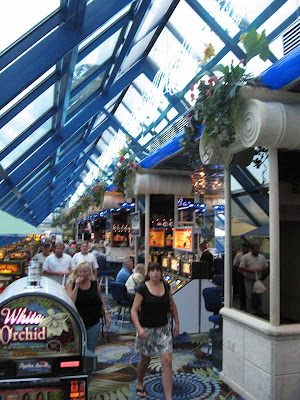 Remember I said there was stuff inside that parking skybridge? Well, this is it. There's a non-smoking gaming area, an Oyster-bar, some other food and drink, and a nifty little seating area at the far end (more on this later). This may be a good place to hide from some of the convention crowds during the day or evenings. Bad news is, there's a greenhouse effect that can make it warm during the day. Should be fine at night.
 Here's the view from the parking bridge of the Convention Center. That's Virginia Street in the center.
 Here's that little conversation area I mentioned. There are a couple such areas in the hotel, unusual for a casino. I like.
 Below is the Atlantis buffet. Not as big as some of the Las Vegas ones, but looks pretty nice. No, we didn't have a chance to try it.
 This sign offers an overview of the dining options in Atlantis currently. Of course that could change by convention time. The Manhattan Deli is apparently brand new.
 Below is the Convention Center and skybridge as seen from the second level of the Atlantis. The skybridge connects directly to the programming room area of the hotel, which is nice if they have programming in both locations. Also, note the crosswalk on the left. Could be useful if the bridge gets too crowded.

 A slightly different angle. Note the parking.
 Above is the program-room lobby area just at the end of the skybridge. The hotel was perhaps more upscale than I expected. I hope everyone is on their best behavior and doesn't break anything!
 Here's a map of the second level, showing all the programming rooms. There wasn't much going on at either location that day, so we didn't have much opportunity to check out the program spaces. One smaller room was open however, and we did get some photos.
 Above is another programming lobby area. Everything is wide, more lobby than corridor. Of course, this being a convention, things may get filled up exhibits, fan-tables and the like, but at the moment, it all looks quite spacious.
 Here's the smaller program room I mentioned. I assume it's pretty typical of the hotel.
 Another angle. For the record, this is one of the "Treasures" rooms on the rear of the hotel. See the map photo for to get a better idea of where this is.
 This is the "Grand Foyer" another lobby area on the second level, near the Napa Bistro. Quite nice.
 Above: the Napa Bistro.
 Here's part of the arcade, also on the second level.
 Here's a view from one of the glass elevators in the Atlantis, showing more of the layout.
 From the elevator looking into the spa level and indoor pool there. There's also supposedly an outdoor pool, but we didn't manage to find it.
 A look at the Convention Center from higher in the Atlantis.
 Looking down from the elevator to the parking skybridge.
 A guest room hallway on the third level of the tower. I assume this is typical. No, we didn't see any of the rooms.
 Looking down into the elevator atrium area. There's another nice seating area in the trees behind the elevators.
 The afore-mentioned seating area.
 Looking up at the elevators.
 Of course, we know what concom, artists, dealer are REALLY interested in. Here are some shots of the loading docks and doors on the rear of the convention center. We figured somebody might find them useful.


 Finally, just because these came out cool, and it really isn't apparent from our other shots, Reno is located in some very beautiful country, and we got a wonderful sunset after a little rainstorm that rolled through during our visit to Atlantis. These photo were actually taken from our room in the Circus Circus Casino downtown, where we stayed this trip. It's just a few miles from the Peppermill in old-Reno.

 Questions? Comments? Go for it. We'll do our best to help.
 Here's a closer look at the parking bridge. It's a large bridge, with stuff inside, as you'll see later.
 Here's the front of the Convention Center. Not a great shot, but it was hard to photograph because of trees. It's bigger than it looks.
 One thing that really impressed us was how centrally located the Atlantis and Convention Center were. Pretty much ANYTHING you could want is within a mile. Dozens of chain restaurants and fast food outlets. Several large grocery stores, including a Grocery Outlet, Safeway, Whole Foods, and more. Two big-box book stores, one of which is seen below. A Super-Wal-Mart. A Michael's Crafts for party supplies. Office supplies. It's all there. It's all close.
 Another shot of the convention center and the Atlantis, giving some idea of proximity. There's a sky-bridge from the second (meeting room) level of the Atlantis to the convention center, but it looks like a bit of a hike, and the convention center itself is long and thin. Bring your comfortable walking shoes.
 Here's a better look at the Convention Center skybridge.
 Here's the back of the Atlantis tower, with more parking. Also in this area is a curious thing, an old style motor-court hotel that appears to be part of the Atlantis. I'm very curious if the concom has any special plans for these rooms. (Chris here: According to the Atlantis website, these rooms are "pet-friendly." If you travel with your furry or feathered friends, you might want to check this out.)
 Here's a not-very-good photo of some of the Atlantis Casino decor. There are escalators to the second level back there, though it's hard to tell in this shot.
 Token shot of the casino floor. They gamble in Reno! Who knew?
 This is the Atlantis registration desk area, seen from the rear of the hotel. It's a bit cramped in here, so lines may be a problem.
 The registration desk seen from just inside the front door.
 Remember I said there was stuff inside that parking skybridge? Well, this is it. There's a non-smoking gaming area, an Oyster-bar, some other food and drink, and a nifty little seating area at the far end (more on this later). This may be a good place to hide from some of the convention crowds during the day or evenings. Bad news is, there's a greenhouse effect that can make it warm during the day. Should be fine at night.
 Here's the view from the parking bridge of the Convention Center. That's Virginia Street in the center.
 Here's that little conversation area I mentioned. There are a couple such areas in the hotel, unusual for a casino. I like.
 Below is the Atlantis buffet. Not as big as some of the Las Vegas ones, but looks pretty nice. No, we didn't have a chance to try it.
 This sign offers an overview of the dining options in Atlantis currently. Of course that could change by convention time. The Manhattan Deli is apparently brand new.
 Below is the Convention Center and skybridge as seen from the second level of the Atlantis. The skybridge connects directly to the programming room area of the hotel, which is nice if they have programming in both locations. Also, note the crosswalk on the left. Could be useful if the bridge gets too crowded.
 A slightly different angle. Note the parking.
 Above is the program-room lobby area just at the end of the skybridge. The hotel was perhaps more upscale than I expected. I hope everyone is on their best behavior and doesn't break anything!
 Here's a map of the second level, showing all the programming rooms. There wasn't much going on at either location that day, so we didn't have much opportunity to check out the program spaces. One smaller room was open however, and we did get some photos.
 Above is another programming lobby area. Everything is wide, more lobby than corridor. Of course, this being a convention, things may get filled up exhibits, fan-tables and the like, but at the moment, it all looks quite spacious.
 Here's the smaller program room I mentioned. I assume it's pretty typical of the hotel.
 Another angle. For the record, this is one of the "Treasures" rooms on the rear of the hotel. See the map photo for to get a better idea of where this is.
 This is the "Grand Foyer" another lobby area on the second level, near the Napa Bistro. Quite nice.
 Above: the Napa Bistro.
 Here's part of the arcade, also on the second level.
 Here's a view from one of the glass elevators in the Atlantis, showing more of the layout.
 From the elevator looking into the spa level and indoor pool there. There's also supposedly an outdoor pool, but we didn't manage to find it.
 A look at the Convention Center from higher in the Atlantis.
 Looking down from the elevator to the parking skybridge.
 A guest room hallway on the third level of the tower. I assume this is typical. No, we didn't see any of the rooms.
 Looking down into the elevator atrium area. There's another nice seating area in the trees behind the elevators.
 The afore-mentioned seating area.
 Looking up at the elevators.
 Of course, we know what concom, artists, dealer are REALLY interested in. Here are some shots of the loading docks and doors on the rear of the convention center. We figured somebody might find them useful.

 Finally, just because these came out cool, and it really isn't apparent from our other shots, Reno is located in some very beautiful country, and we got a wonderful sunset after a little rainstorm that rolled through during our visit to Atlantis. These photo were actually taken from our room in the Circus Circus Casino downtown, where we stayed this trip. It's just a few miles from the Peppermill in old-Reno.
 Questions? Comments? Go for it. We'll do our best to help.
 We're also likely to be making other trips through Reno before the convention, so if you have specific information requests, we'll try to help as best we can.